EDWARDS AIR FORCE BASE, Calif. -- This article is courtesy of Stanford University. Original Story: https://news.stanford.edu/stories/2026/01/researchers-air-force-test-pilots-ai-copilots-safety
Stanford engineers partnered with the U.S. Air Force Test Pilot School (TPS) and the DAF-Stanford AI Studio to evaluate how an AI “copilot” could support pilots during the most demanding moments of flight. The system was designed to help pilots diagnose problems, reduce workload, and respond faster during emergencies where every second matters.
The collaboration originated in the Stanford Intelligent Systems Laboratory, led by Mykel Kochenderfer, associate professor of aeronautics and astronautics, which focuses on developing decision-making systems for safety-critical environments. As a third-generation pilot, he emphasized the stakes: “Pilots train intensely for emergencies, but accident databases show that many mishaps stem from human error. If we can get the right information to the pilot as quickly as possible, we can significantly improve safety.”
The researcher developed and tested the system using a simulator – and it also made it to the cockpit of a Learjet 25 as part of a Test Management Project, a capstone in which TPS students design flight-test and safety-plan programs.
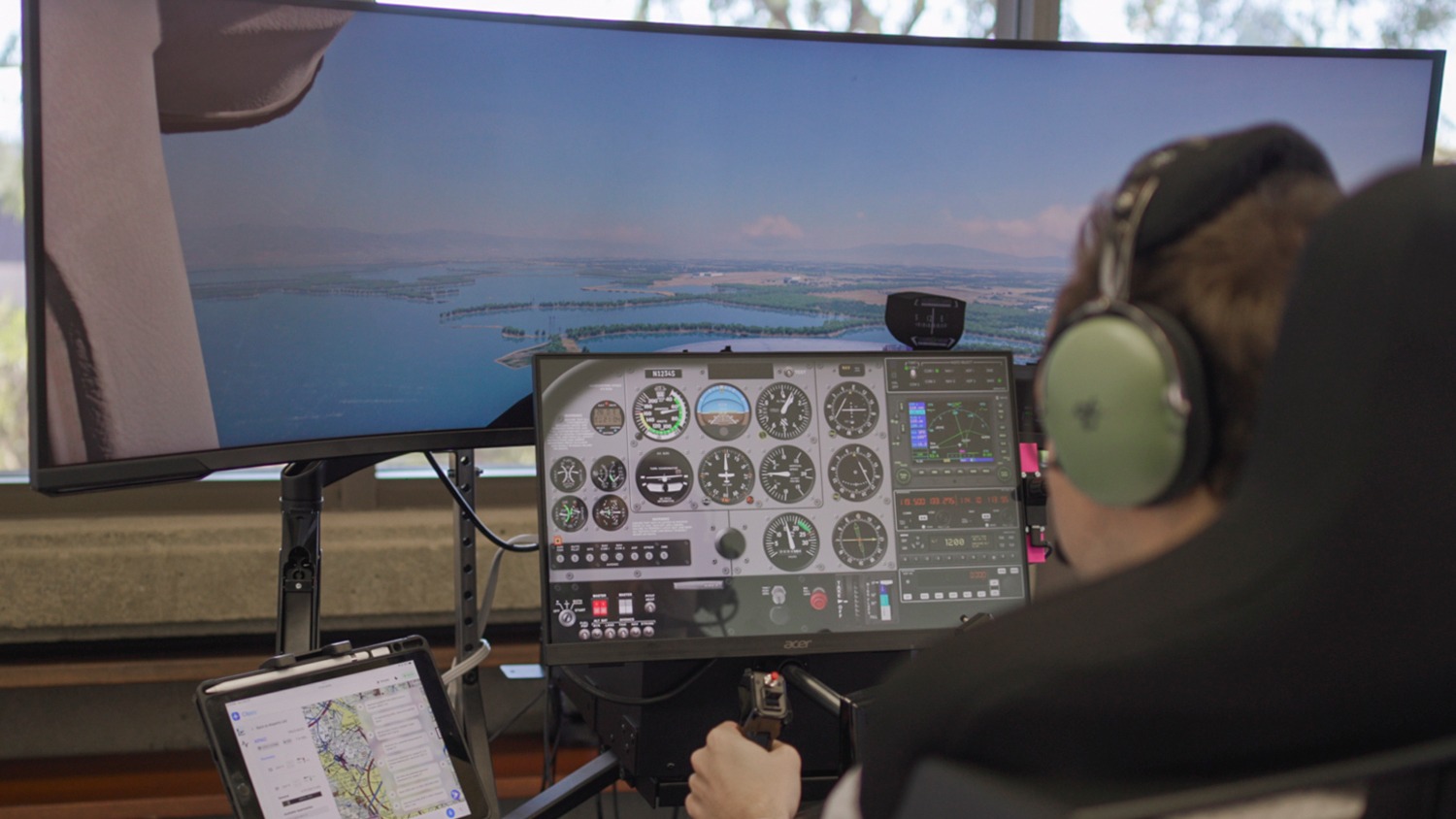
A flight-simulation platform and in-aircraft testing aim to show how AI could help pilots make safer decisions in emergencies. (Courtesy photo)
Cool under pressure
Running on an iPad, the system relies on retrieval-augmented generation, a system similar to a highly advanced “Ctrl + F,” allowing it to instantly search documents for relevant information.
PhD candidate Marc Schlichting said the system could assist pilots across a wide range of emergency scenarios. “When a pilot spots an anomaly like a warning light, time is always the limiting factor,” he said. “Normally, they’d flip through checklists and manuals to diagnose the issue, but the assistant can scan those and return guidance within seconds. It may not sound like much, but in an emergency, those seconds matter.”
Knowing AI’s capacity for making up or twisting information, the team worked extensively to reduce the risk of hallucinations, so pilots can trust the assistant’s recommendations under pressure, explained Kochenderfer.
To test their work in controlled but demanding conditions, the team used a full-motion research simulator in the Stanford Department of Aeronautics and Astronautics. The six-degrees-of-freedom platform features an immersive curved display and controls that provide realistic vibration and resistance, allowing researchers to stage rare, complex, or cascading failures that are too dangerous to attempt in flight. Schlichting described the simulated scenarios as “a pilot’s nightmare in a controlled setting.”
In-flight tests
To test the system in a more realistic setting, 24 TPS pilots flew a Learjet 25 through two custom scenarios: once without the AI assistant and once with it. The goal was to measure how the system affected workload, decision-making, and pilots’ ability to diagnose hard-to-interpret system failures.
Maj. John “Heater” Alora, director of operations at the DAF-Stanford AI Studio, said the collaboration was a “natural fit” because, “Stanford is advancing the frontier of AI and autonomy while TPS is the nation’s leading institution for testing new flight-system technologies.”
Capt. Jorge “FAIR” Cervantes, a TPS student in Class 25A and member of the test team, said the flights helped him better understand “how pilots chose to interact with the assistant, what information they trusted, and what follow-up questions they asked under pressure.”
Understanding these behaviors is important when considering how this technology could scale for future use. Alora said AI copilots could benefit many areas of aviation.
“What’s really exciting about this technology is that it has applications for both long-duration military missions and enhancing safety and workload management in commercial aviation.”
The results of this work are still being analyzed, and the researchers plan to detail them in an upcoming paper. They are already using the valuable feedback they got from the flight tests to improve the system and have a new version of the assistant that talks to pilots and has vision capabilities.
“Each phase of testing were baby steps toward building the confidence required to deploy AI assistants responsibly and reliably in safety-critical environments, and ultimately, to make flying safer for everyone,” said Kochenderfer.
This article is courtesy of Stanford University. https://news.stanford.edu/stories/2026/01/researchers-air-force-test-pilots-ai-copilots-safety